Their Waters Were Mingled Together
Sword of the Sea

On May 24, 2023, the newest works by my two favorite studios were revealed to the world within ten minutes of each other. One of which came out last year, and the other a couple weeks ago. I feel unbelievably lucky to have played them both, but the latter in particular because I don’t think there has ever been a game made so especially for me. Sword of the Sea is a triumph in every conceivable sense, reinforcing the core design philosophy of Giant Squid Studios while redefining what it means to find yourself while holding a controller.
Sword of the Sea is a musically driven fantasy action game in which an ancient suit of armor is brought to life in order to bring back the long-dormant ocean that’s been dried out for centuries.
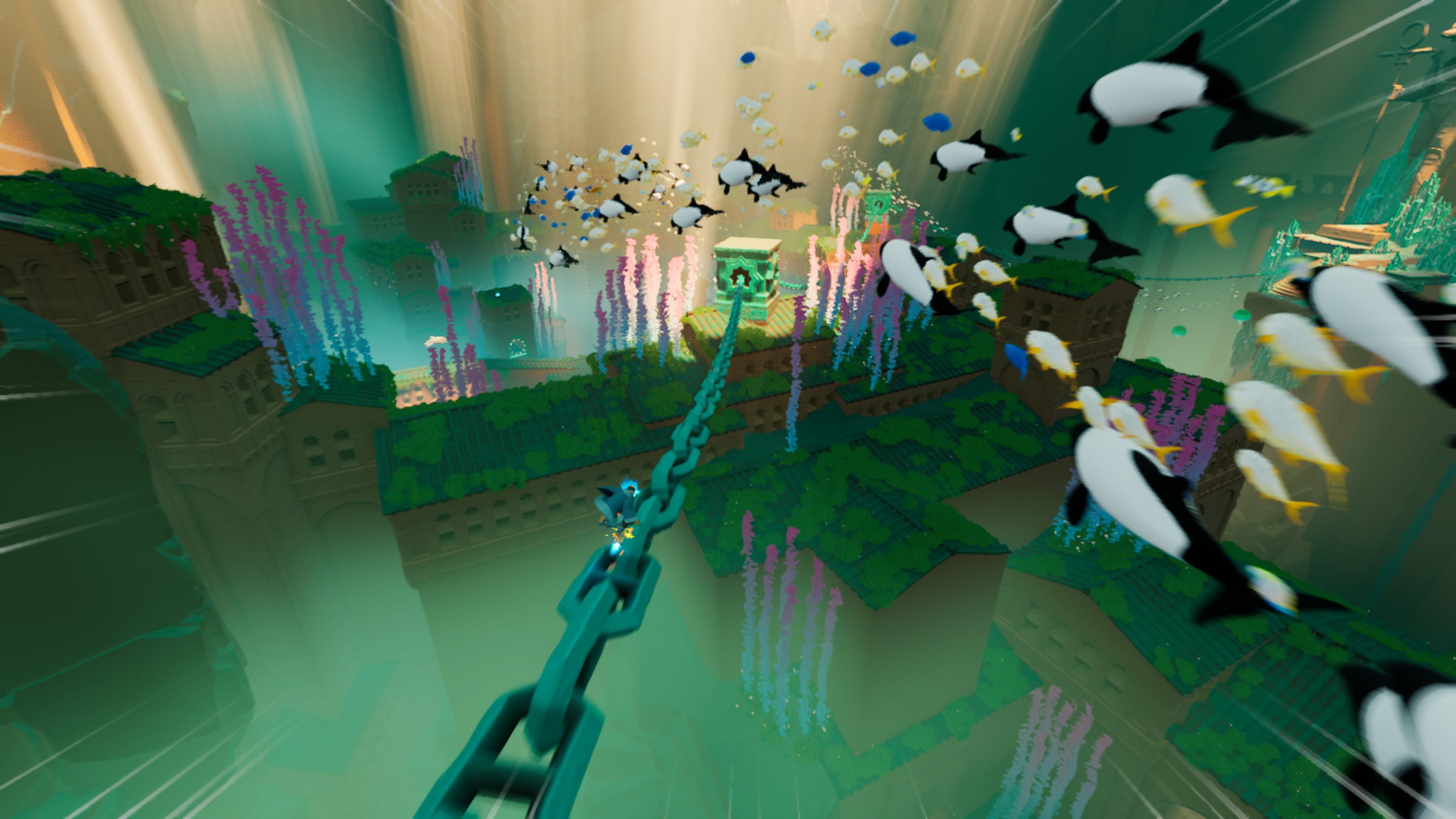
This feels like the first game in the Giant Squid anthology that I feel wouldn’t land as well if you haven’t played the others. The promotional material has always led with “from the visionary artist behind Journey, Abzu, and The Pathless” and this functions as a prerequisite reading list of sorts. Sword is an unforgettable thrill ride in its own right, but I have a weird feeling that some of the big moments in the story won’t have the kind of impact on a completely fresh player that they did on me.
A pod of dolphins breaching the water as your surfboard shreds through the stream; emerging from an underground temple to find yourself at the foot of a snowy mountain with tattered red banners whipping in the wind; learning the secret identity of the masked surfer you meet along the path… all of these things have roots in the first three games and tie the universe together. They’re probably cool on their own, but having studied the previous games attached a lot of emotion to these striking images. Abzu tipping its cap to Journey and The Pathless tipping its cap to Abzu were merely small flourishes in comparison.
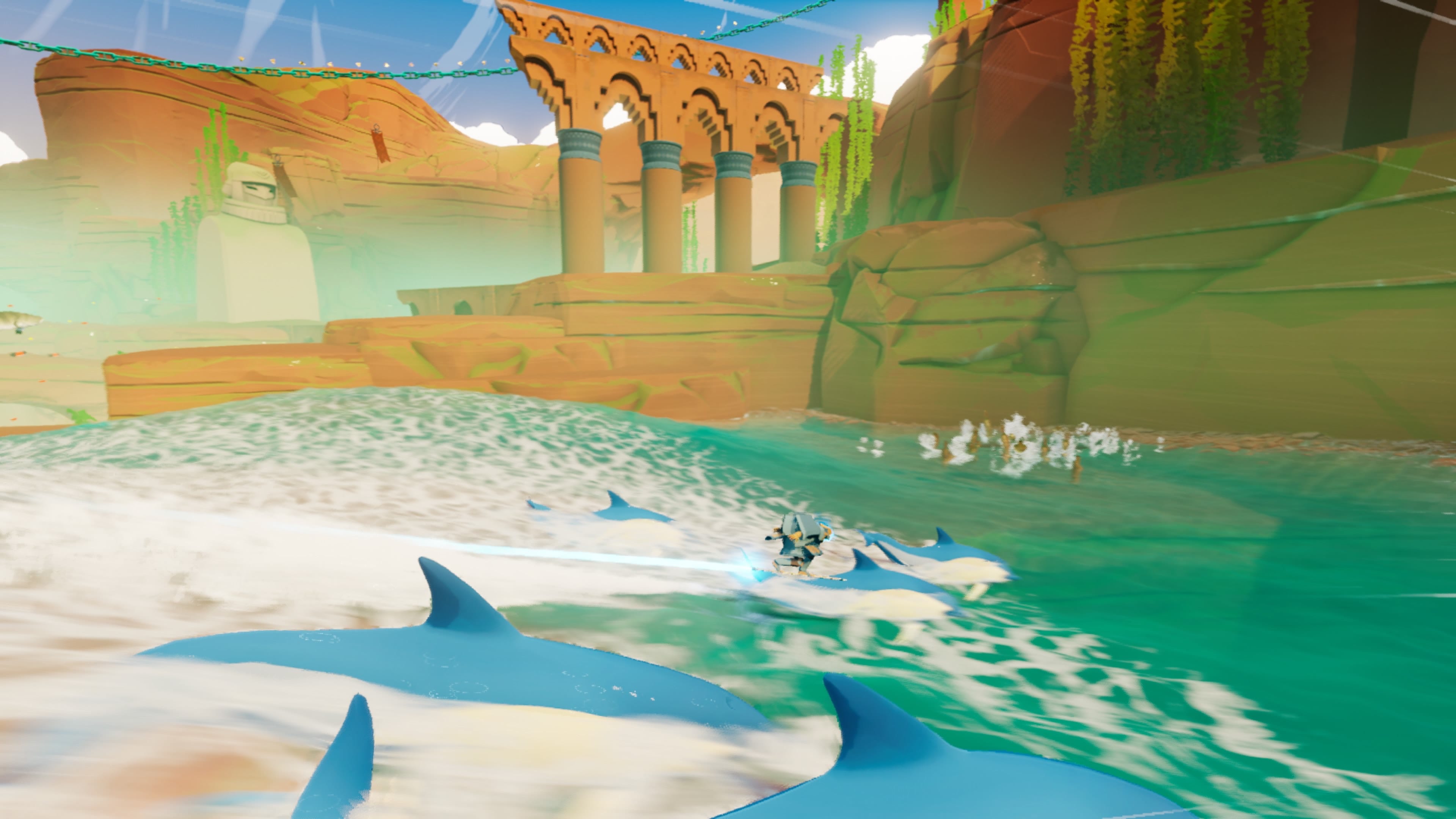
But don’t think even for a second that that’s a complaint. Sword is the ultimate love letter to the works that shaped my outlook on gaming as an art form. Matt Nava’s greatest skill as a director is juxtaposing a towering, monumental scale that makes the player feel like a tiny speck in an infinite universe. This game is no different, except it builds an even more deliberate foundation of slick, fluid movement than ever before. The protagonist might be surrounded by an endless expanse of sand and heat, but its surfboard is one hell of a way to get across it. A strong sense of progression follows each chapter when it comes to raw speed and trick capability. I now know what it’s like to do a kickflip on the edge of the world, a tailspin off the crest of an impossible wave of shimmering snow.
Even with these enormous worlds to explore, getting from place to place never feels dull. The sound design, accentuated by the DualSense speakers and vibration texture patterns, gives some serious kick to the surfboard’s engine. Landing any sequence of tricks and angling the board to align with a downhill slope results in an ignition that becomes so addictive to seek out. You can so clearly feel the pull of gravity as you're turning and cruising, and when that downhill kick starts to wear off, it’s almost as if the board is begging for you to land another big jump to accelerate once again. Part of the fun of revitalizing the ocean in each region is the sheer jump in velocity when your board is tearing through the water as opposed to sand or gravel. I never got sick of the rush that came with revving the board into gear and flying from dune to dune.
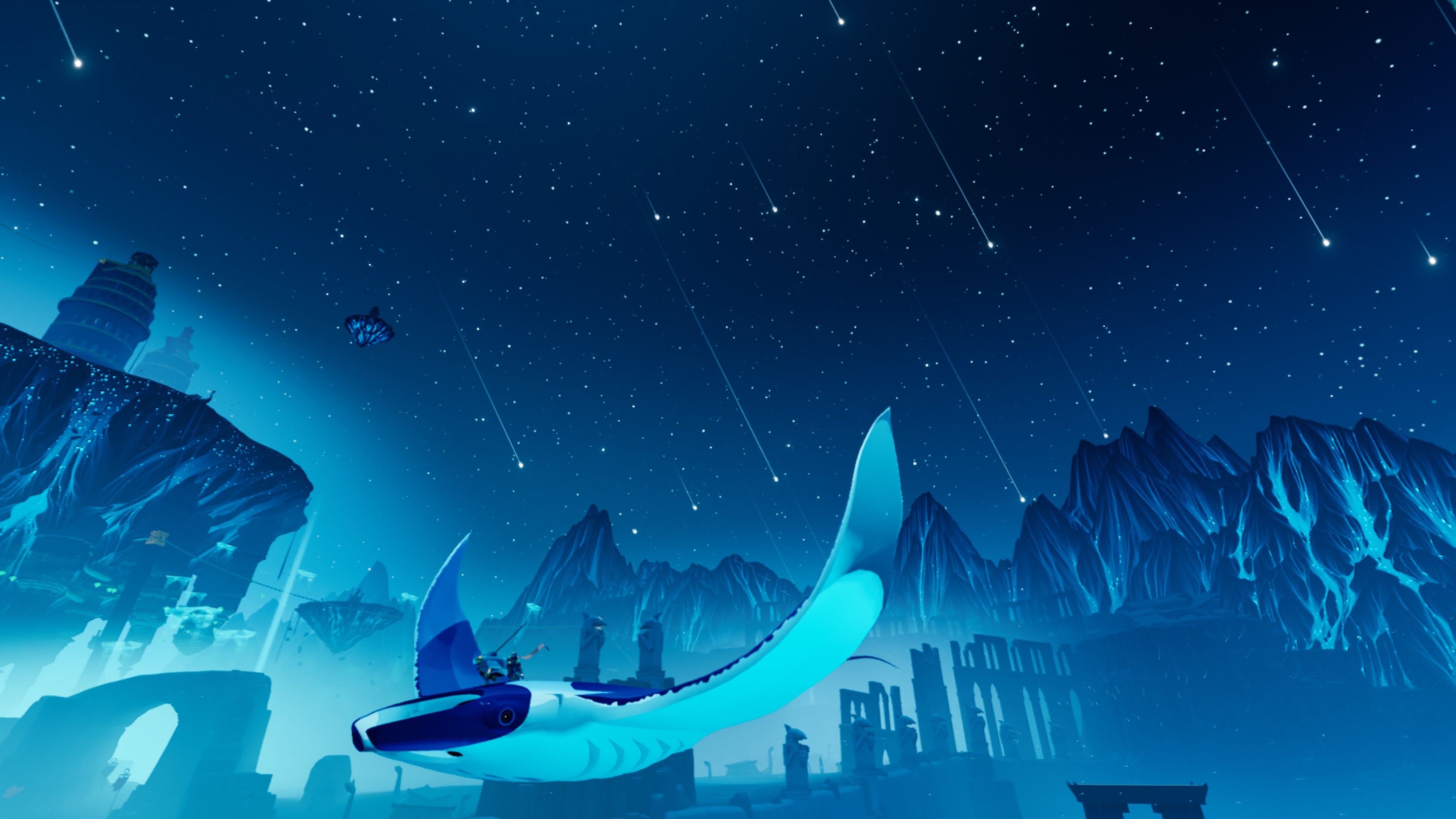
In most games, I find myself doing the main objective last so I can collect whatever I’ll find in the environment. But here, I started doing the opposite because the waters flowing meant I could blaze across an entire canyon while a school of fish dances around me. But the action isn’t the only exciting draw, as numerous eye-of-the-storm scenes are scattered about for you to discover on your own terms. One of my favorite moments of the whole game was resting on the back of a manta ray watching the shooting stars scraping through the horizon. Sword is full of little beats like these which provide a second to sit back and soak it all in as a respite from the chaos. The perfect pacing really makes you see the finesse and polish that went into everything from the first frame to the last.
No review of this game could be complete without paying the praise due to its musical mastermind. Austin Wintory turns in his most sentimental, heartfelt score to date with a wildly inventive flair. You almost never hear a piano-centric score from him, but I think it’s perfect here because of how quickly it can convey shifts in momentum, which is exactly what a locomotive game like this needs. As one can come to expect from a composer best known for his exploration of thematic storytelling, the core 16 bars of this game shift into dozens of shapes and are translated by various instruments into dozens of languages. The newly crowned fourth universal theme, “From a Drop, a Flame,” dynamically surges and beckons to the passion burning within anyone to become the change they wish to see in the world. Including the Phoenix Boys Choir in such a prominent role felt like a choice that represents a hope that will never die despite what tries to suppress it. No matter what things have come to, Sword asserts that there will always be a chance for the world to dance again.
Not lost on me is how the first chapter is set in a desert with a great mountain in the distance and is led by Tina Guo’s cello, then the second chapter abstractly recreates the ocean floor and its lead instrument is Kristin Naigus’s oboe. But the coolest choice on display here is probably the solo vocals— hauntingly performed by Malukah— which becomes the vessel instrument of this game as the cello is to Journey. The idea of her as this omnipresent figure watching over the player is one that further reinforces the ideas of a greater purpose. Her solo parts become more and more pronounced as the waters begin to flow again, almost making her a North Star to the player. Hearing her sing “From a Drop, A Flame” in its purest form during the credits was the perfect resolution to the story and was everything I could ever want from my favorite composer.
Wintory innovates on his interactive cue variation system from The Pathless to create numerous unique orchestration profiles within each locale which not only are gorgeous to listen to, but provide me with an intrinsic motivation to explore every square foot of the playable space. Each revitalized spring augments the cue you're hearing to fortify the vivacious soundscape of the floating ocean in between its phases of tranquil introspection, wistful mourning, and surging triumph. Maybe I’m a dork, but I just can’t get enough of his work. The music of the Giant Squid universe is a living, breathing organism that weathers and changes with the seasons.
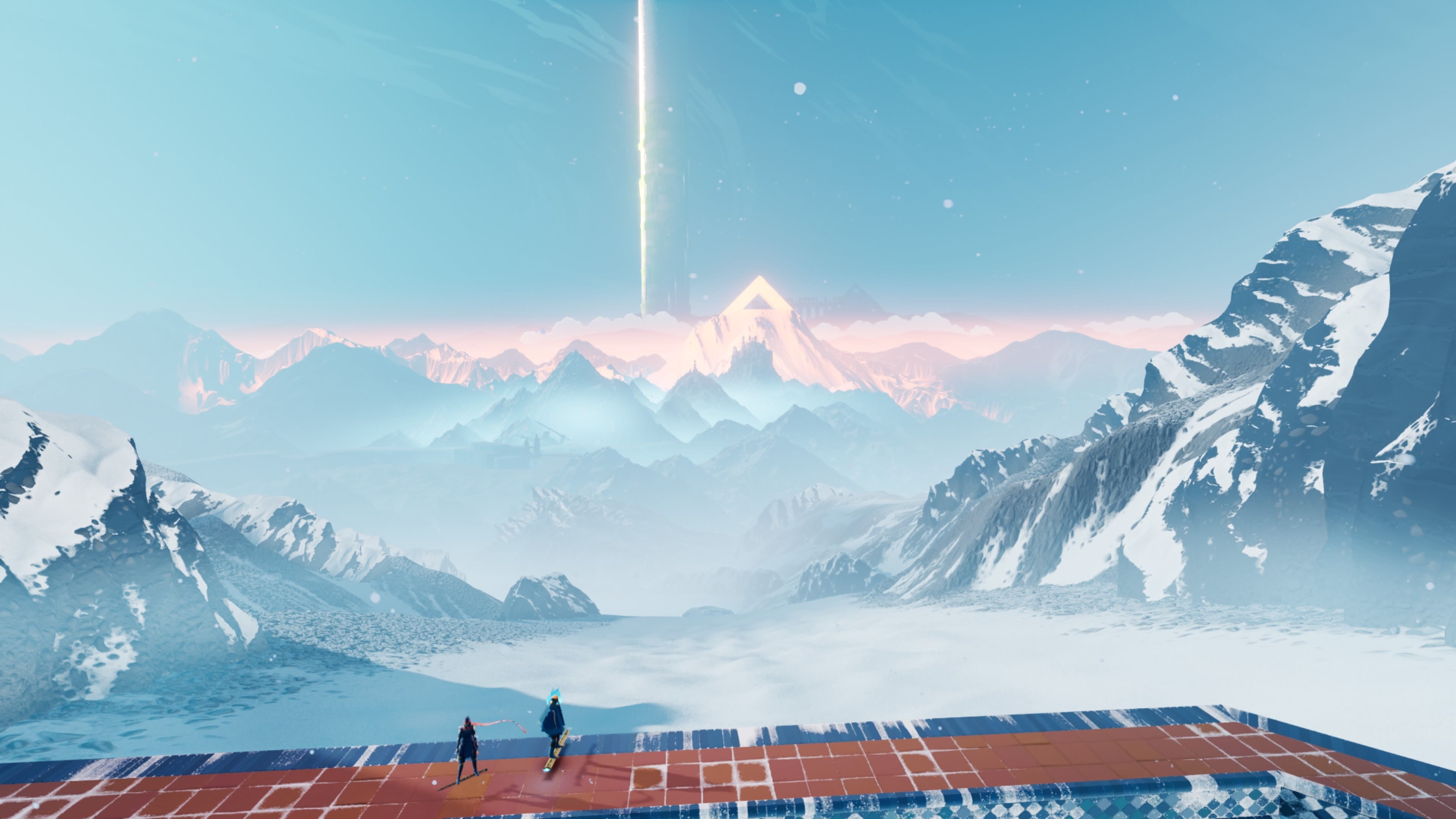
Even though I feel it draws the most from Abzu when it comes to scale and design, this game feels like the truest possible successor to my favorite game ever made. Where Journey is a rebirth, Sword of the Sea is a homecoming. Nava, Wintory, and the whole team have created something truly special that I already know I’ll be cherishing for years and years to come.
Thank you for reading! I hope you consider playing this game, and if you do, please tell me what you thought!